Showing posts with label instructions. Show all posts

Friday, November 13, 2020

Felix Grainline Revisited: The Fin

I'm shocked I didn't write about this dress when I made it in 2019. 
I think I just didn't want to dwell on another epic fail.

 I had enough fabric leftover to make a couple of masks to go with it this year, so it got a little more love around the house.

Matching mask and dress. There are many matches when your stash is 95% novelty cotton


I did wear it pretty frequently this summer. I do not like the pattern.
 I really hated it at the time when I finished it.
Useful clues:
I had never made a Grainline pattern before this, I was not familiar with the fit profile.
Not useful clues:
I did not line it, because it doesn't need it. The collar/facing finishes itself and the inseam pockets are close to the outside seam and not big enough to need the internal support.
The measurements had enough slack in them to just make out without a toile. 
It's a pullover dress for light woven fabrics.
HOW HARD CAN THIS BE?
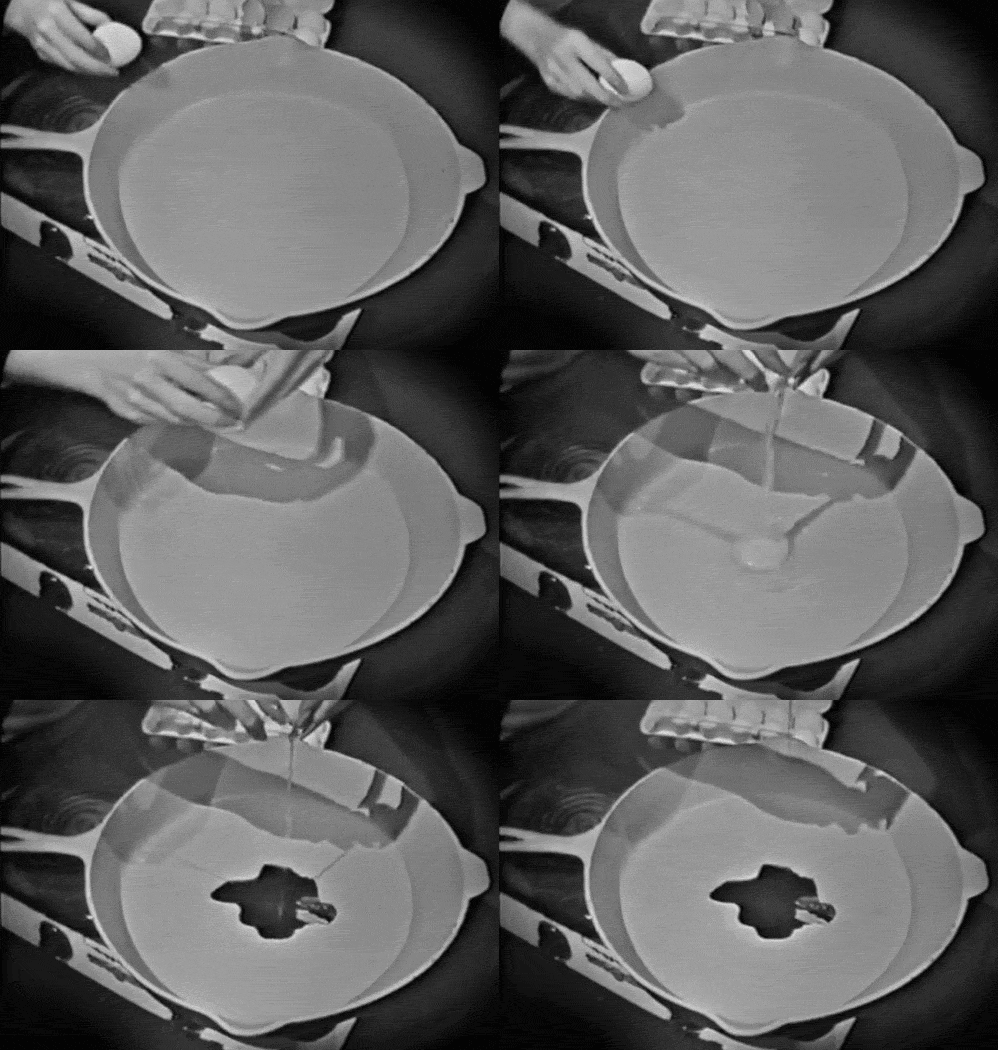
Ernie Kovacs, from Giphy


I love this Alexander Henry print, I love how the black collar really pops (which is why it lived in heavy rotation) and sets this fabric off. I love what the dress should look like.

And looking at the photos again, I can see where it went wrong and why it irritates me.
Grainline illustration from website
Several makes of this dress, including the designer, has the same problem:
it's got a fin in the front.

http://www.stonelakeroad.com/home/2019/5/13/two-felix-dresses
https://grainlinestudio.com/collections/dresses/products/felix-dress?variant=22533591040082
When more than one person has the same issue, it's not operator error.

To figure out where this went wrong, I had to reverse engineer it. To see the pattern, I had to figure out when I had purchased it, and where I had put the PDF on my computer (or had I deleted it entirely in disgust? No, but I did toss the printed pattern.)??

Grainline Patterns photo from website

I did find the photos, still unedited, in that month's folder.
I was really steamed about it, as the skirt stuck out in front like the photo below
(and this is the cut down version of this effect).
Hanging up in the website photo, the center is nice and flat, but there's a lot of skirt there. And the back of the skirt is coming forward to the front, just on the hanger. It's all pulling to the front.
My dress enters the room before I do

Selfies from work last summer. Not my pinball machine.
This is the problem
see that? I have a front fin and it hikes up in front. A lot. 

I could not figure out why I have so much fabric in the front in relation to the bodice: I had cut the same size for the skirt as the bodice, and if I slipped up by a size, I wouldn't have that much (and it's a LOT) fabric in the front.

Now I have cut that down (and cut it down again),  and it's manageable (mostly because I love the print/black contrast neckline). I tolerate it.
I have a lot of process photos, but this one of adding the neck facing is going here because I like it.

I wore it a lot; that long v neck with the facing collar is very flattering, it feels good to wear (not every dress wears well in quilting cotton) and it's different from the usual subjects in my closet. The pockets are a bit short (almost 7" deep, not quite enough for a phone and all the potential volume). 
I was going to trim down the front skirt, and continue that skirt gather to the back in a swoop

red line is new style line
Like this

But this is not going to solve it. 

Aubrey Plaza for drama


So what do I think is the problem with this pattern?
The neckline/shoulder seams pull the dress up in front: also, the front v neck should be longer, the skirt/bodice seam is unequally curved. Mainly, it's out of balance from front to back.

I got the idea from Dressmaking Debacles.

http://dressmakingdebacles.blogspot.com/2018/08/grainline-felix.html

"I'm thinking the neck/shoulder fit on Grainline just doesn't work for me. I believe it's meant for a more erect back; the shoulder seam is WAY back on me and I do not have forward shoulders."

And she has the same issue with the skirt in the front.
The neckline is pulling the dress up and to the back.
Look at the selfie profile photo again (it hurts me to look, you go ahead)
The quantity of fabric in front isn't helping.
Oh dear.
I do like the style lines.
So, my solution is simple.


I will be adding these style/seam lines to an existing TNT a-line sheath pattern.

The more I look at the seam line between the bodice and the front skirt on this page, the more I see how it adds to the problem in the front.  The top of the front skirt panel is too flat, relative to the width and curve of the bodice. It's not a lot, but just enough to create that front fin and skirt ride-up. 

I could correct the pieces to make this adjustment, but then there's the angle of the bodice vs my torso.  There's just too many moving parts to get them to fit. I'm really better off just tracing off a new TNT 'a line' dress pattern, drawing  the style lines on it to add the deep v collar (faking the overlap which has no practical purpose) and adding seam allowances as necessitated by adding separate pieces. 

I did add a tiny modesty panel at the base of the v neck, It's deep for me,  as I am actually a pretty modest dresser. My skirts have crept up from shrinkage over the years; I do have some deep seated issues about my knees it seems.

In reconsidering this pattern, it does offer an opportunity to salvage another dress that's been lurking in the WIP pile.
Maybe that long flat facing 'collar' is a solution to this

I love novelty prints, but they can be overwhelming, and it's nice to break them up with a solid trim, or just embrace the insanity and add another print to the mix.

Percy will approve

Sunday, July 5, 2020

Dear Threads, I can't see what you did there

I have a mixed relationship with Threads.  I subscribe. They don't always have articles I am interested in, or something I want to read how to do.  Sometimes this lasts for months. I subscribe because I want to keep them in business for the issues when they do.
Like this one.
This magazine is made by humans, and us humans all make mistakes. Maybe a page got left off, or a color got switched.
This month,  I have questions.
These examples are all from the new September 2020 issue #210. 
Normally, I will see something that's a little off and file and forget it. When several of them occur in one issue, I crack open my letter to the editor 

NOTE: You will need to enbiggen to read these. I did not write them, so I have watermarked them and taken out some of the instructions, as this is NOT MY WRITING. Not pretending it is, either.
Disclaimers disclaimed.....

I've been adding sleeve heads into stuff, so I read this article with interest.
And I'm confused. It feels like the last step has been left off.

We get a lot of information about what to make the sleeve head out of.  We get photos of the inside and the outside.
What do we do to finish the seam?

I can see that if it's a jacket that this is all going to be covered up with a lining.
But if it's a blouse, we've got a lot of raw edges here.
Does that organza roll back over the head to finish it off? Or do we leave it raw?

I did that on the Journey jacket, it's ....meh but the sleeves are unlined and I wanted a consistent finish on the interior seams. For looks and for comfort, I want a finished armscye.  I'm also looking for a better finish on this (I've tacked it in to get the shoulder to pop and I'm still poking at it).
this is the inside of the jacket flipped to the outside, and that white stitching is temporary.
I genuinely would like an answer to this question. 

Another article (same current issue) has the classic error of illustrating a technique with the fashion fabric. The problem is either the fabric is black or (in this case) the fabric looks the same on both sides and none of the relevant stitching shows on a beautiful but very busy print. This is a really great technique as far as I can tell. But I can't see it, and I would like to.

In the name of fairness, I have a similar problem with black counter tops and cork floors, which I cannot see the growing moisture ant population on. I understand it is easier to gawp and complain than make a better example. I mean no harm by this.

I'd like to move to a good example of a sample (same issue), that which Threads is known for.

In the sample garment, you can see which is the wrong side of the fabric and which is the right (bonus points for contrasting facing pieces). The drawing on the left is a trifle unclear, I think the photo does a better job all by itself. In my sample diagram on the right I have added the clashing colored layers to the diagram. I think their diagram is more an example of the color themes that they use in their magazine. Some people really like pinks and beiges for their websites and magazines. Some of us don't. Guess which one of us still has a magazine?

The point here is: THIS STUFF IS HARD. I'm not slagging anyone; you can always see the mistakes after you've finished the job. It's even easier after someone else finishes the job. Writing this,  I can see several better ways I could illustrate that diagram, but I have to go wipe down that black countertop again. 

I get to live with my mistakes..

Sunday, September 9, 2018

Pattern Review is Still My Girlfriend

8813. In plaid. Theoretically strong.  Needed more definition.

I pulled this section out from the other posts, because it's so far offtopic it should have a set of bus routes, a water district and a library.

The problem comes from reading the directions. Because for once, I'm gonna read them.
See the space between the end of the piece and the top of the next piece you're sewing to?

In this illustration, you can see there's a distance from the seam join to the top of the pattern piece.

It's right there


In illustration #3, you can see there's a distance from the seam join to the top of the pattern piece.
In real life (yes, I shortened on the alteration line. I am short), there's about 3-4 inches distance.

But in this illustration (#5), it's just a seam allowance distance.

And this illusion continues to the next illustration (#6)
As it turns out, the discrepancy in the illustration is not a problem. It's just a drawing error. That transition at that corner did trip me up, and I had to unpick and topstitch it.

However, sometimes it's a problem.
https://sewing.patternreview.com/
 PR, here i come.

Now, as readers of this blog will note, I have ISSUES with PR. I linger every year over the 'do I give them my money and for what?' at renewal time. And I renew, I just renewed, because I do get something out of it, and I do want to encourage more of this peer review of patterns. The knowledge bank is deep, and full of Ann Smith's work on Miyake Vogue patterns (which is half how I got to this).

Generally speaking, I read the lowest scoring reviews first. I want to know if there's some ghastly rotting corpse in the instructions or the pattern pieces. Even Vogue has some horribly done patterns still in rotation. 
https://voguepatterns.mccall.com/v7464
You will make friends online over this one. You will have to.
This 40s vintage hat pattern that is missing half its instructions is still for sale, and is  still missing the second half of the instructions (and I took a hat making class and still cannot chalk that one up to 'you need additional millinery skills for this'. No.) 

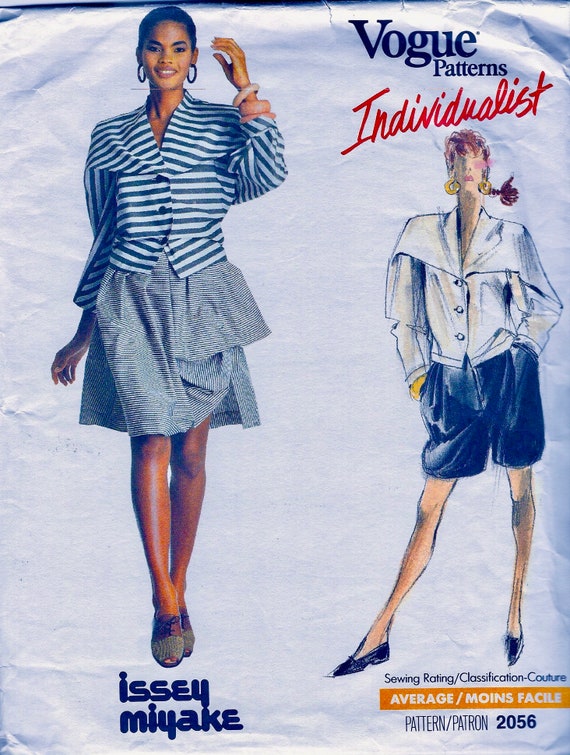
On a wider view of the pattern world, there are plenty of patterns that make no sense TO ME* and have loopy instructions where you wave your hands over the pieces and they must assemble like Autobots or Avengers, all on their own. I like my match points to match. Miyake's blouse 2056 may be a mess of match marks that has defeated me SO FAR, but I know in my heart this does work.
There is no real proof of this shirt working yet. If you have succeeded, please comment and explain.
However, there's 
 https://erniekdesigns.blogspot.com/2013/04/miyake-dress-1309.html
which DOES work


A dress that STILL fits me, twenty pounds later. Don't overlook this feature.
But clearly I have digressed:
Pattern Review, Vogue 8813 is a busy page.

25 reviews (23, two people reviewed it twice) and all of them made major alterations to the pattern. Even the ones that indicated they did not in the summary, made alterations of significance: added waistbands, buttons, sewed up the v-neck, major FBA, armsceye 'creation' (adding a dart to the bottom of the sleeve to create a fitted curve - a reverse gusset).  One relegated it to the Halloween dress up pile. People who rated it five stars and would recommend to a friend would not make another one. That's not a recommendation. 

 I do want to remind you that sometimes, it's really not you, it's the instructions or lack of instructions. More often than not, pattern pieces weren't reassembled to verify they fit together. Some patterns have a lot of moving parts that are hard to keep track of. Even professionals screw up. Stuff happens.

Remember how to make a peanut butter sandwich?

https://erniekdesigns.blogspot.com/2017/10/instructions-are-hardest-part.html

The pattern I did for SewBaby turned out okay, but it only turned out because we spent a billion years on the instructions. A BILLION. It's day is over, it wasn't the greatest coat for toddlers (though a very good bathrobe....it has the 'sew miles of bias tape around the edges' problem. Snoresville.)
Look, my patttern is in the bin at Value Village! Uncut...oh that's not a good sign.

There are different levels of instructional engagement. Some people need to know where to sew A to B. Some people want to wing it. But I insist that there are patterns that are just unsewable because they were drafted off an object that the drafter did not understand. Go look at that hat again. I'VE BEEN THAT DRAFTER. I've made that mistake.

This pattern broke me.
I think that a pattern is a promise that if you read it and follow it's directions with care, you will have a result that will look like the photo or the drawing. If you have basic skills and are willing to do some learning on the job of new ones, you can produce results that are consistent with the image you've purchased. If you are a beginner and you try a 1950s vintage ballgown, you will have plenty of challenges, but you can do it. 

Or if you're 18 yr old me and you're ruining some Harris Tweed  - the only Harris Tweed you will ever touch - to make an ill-fitted suit for a friend.
It did look like the drawing. It did not fit her. I followed the directions. I had to look some of the procedures up in a book in the library (this was 1977) but there were directions to follow and I followed them. Except for the one to make a toile to check the fit. I learned a lot. I also lost a friend.

Remember Rue.
https://www.colettepatterns.com/catalog/rue
https://ciaraxyerra.com/2016/10/04/we-need-to-talk-about-the-rue-dress-some-more/

*this is my blog. I am entitled to change my mind. Or not.

Sunday, February 18, 2018

Coat assembly instructions


Sewing a coat is like sewing a car. It has a lot of parts and an order to assemble them in.
Every time I've sewn one, I've made a list of the tasks, the parts, and used my time to arrange them in the order I need them to get done in.
I am parking this list here for my future benefit.
There is one highlighted activity in the middle that came up this week. 
Oh, you'll see it right away.


The raincoat has a sleeve and upper body overlay as well as the main body piece, pockets that were internal and outside welt pockets. And it's fully lined. This made it complicated in ways that the winter coat is not.
Nevertheless, much of the same process applies.
So, for your entertainment, and an explication of how you can take a complicated task and break it down into a long list of five minute activities
(or: what I learned I could do during a child's nap time, when I had napping children), here's the list. 


Raincoat 2017 assembly instructions
Materials:
  Things that need sealing:
  Upper front shoulder seams
  Hood seams
  Collar seams
  Welt pocket seam
  There is so much fabric at the placket and overlays, I don’t think that needs sealing
Order and name of Layers:
  Outer: upper body overlay, main body
  lining: main body
  mesh for upper body overlay
Zippers
  One long center zip with placket/flap to cover/underlie (zip flap opens to right hand)
  Two shorter coil zippers on lower side seams to close in windy weather

  Two Interior pocket zippers

  Anorak snaps for placket
Seam tape for inner zipper finish, collar, side zips. Grosgrain, whatevers….
ASSEMBLY
Assemble fronts
Stay stitch neck seams all pieces
  Baste front/back linings together at shoulder seam and mark for pocket locations, adjust fit. Remove basting stitches.
  Sew Welt pocket through outer fabric (outer) to oversize lining pocket rectangle (both sides). Seam seal, let dry.
  Sew inside pocket to lining at chest height (both sides) and add zippers to tops to close.
     --finish ends of zippers so they don't uncoil and snag clothes
I'm not showing you the snagged sweater, but there were some tears. I'm adding some ribbon over the ends. The coil wants to uncoil. It wants to be free.
Nice little fishhook it is.

Happened on both sides of both pockets

  Finish outer pocket, wondertape to outer fabric to secure.
  Sew outer front to back at shoulders,check pieces to line up at center – ZIPPER BASTE?
  finish shoulder seams = ‘body’
  Sew front to back mesh at shoulders, finish seam
  Attach mesh to lining, finish seam
Assemble upper fronts
  Stitch upper fronts together at shoulder seam, sew outer hood,
 seal both and let dry
  Hem 1” leave side seam ends open. Do not finish cuffs. Be careful about matching hem position at center seam
  Baste upper fronts/outer hood at collar seam. Adjust for fit. Stitch, seam seal, let dry
Hood assembly

  Sew hood lining, stitch seams open.
  Baste stiffening material at center brim section (horsehair trim?)

Final body assembly
Sew all side seams, checking upper hems to match
Sew Short zipper to outer fabric (with end join at side seam), fold under lining to cover zip tape on inside
Baste outer fronts and backs to lining Check and stitch
Sew lining  hood to lining. Check with outer hood assembly to match. Flatten collar seam.

Sew hood and lining to outer hood at front hood edge. Turn and topstitch
Cuffs? Turn later? Check for length and turn later?
Secure layers together at center seam. Leave it open to add zipper?
Big outer pocket will need tacking to lining for support.

Zipper placket
Placket will get a couple snaps to close quickly (two at hood part)
Mark zipper both sides with thread at hood collar seam intersection
Baste zipper and unfolded flap to front finished upper/front/lining .
Order is front, then flap wrong face to right face of front, then zipper on top: stitch together, leave a lot of zipper tape open.
Yes, I made myself a diagram because I knew I would forget. And no, I haven't put the zipper in the raincoat yet. Fall Raincoat season blew by in a week. Now it's winter. Don't worry: there will be a Spring raincoat season. A long one.

  Fold flap  and zipper out, fingerpress and stitch to secure front
  Fold flap over zipper to cover, then back and  turn under to seam.

Finish cuffs with fold and topstitching

Trim flaps to match sides

And this is what I think about when I go to sleep at night. It's boring enough to put me to sleep, thinking I've done my duty and can sleep well.
And since I've put it here on the blog, I will be able to find it again.

Sunday, October 22, 2017

Instructions are the hardest part

The pattern is easy. 

Think about it: telling someone how to do something and assuming they have no prior knowledge of a thing is tough. It's very hard to assume they don't know what you already know.

This is a video from the reboot of the PBS kids show 'Zoom', where one kid tells another how to make a peanut butter sandwich, and the maker has to follow the instructions literally. They repeat this exercise several times.

How to make a peanut butter and jelly sandwich
(once you get past the obligatory YouTube ad, the video cues up to the beginning of the skit)

Assume nothing.

I think the dean of instructions is still Ruth Wyeth Spears.
Her work may look familiar


Very familiar


She's not complaining about this, either.

Yes, I put this right in the middle on the back.

I've spent enough time with Japanese pattern books to know that you can get a lot done with a clear illustration. I have virtually no knowledge of Japanese kanji (I know the word 'kanji' though!) but I've made enough clothes to get what the diagrams are supposed to show me and in roughly what order.

Okay, so they're doing an one piece facing above, and separate facings below.
The instructions below are from 4411, identified as 
"Simplicity Primer - Guide for cutting - sewing - detailed dressmaking"
Yes, the words are useful, but do you even read these instructions anymore?

I'll admit it, I buy patterns for instructions. I can figure out most stuff, and I have to redraft so heavily to fit me, it's barely worth the tissue and tape to cut out a new one. More often than not, I graft details from one item to a TNT.


Love that shoulder pleat!

Literally, the trick is a pleat at the shoulder line on the front piece. Nothing more than that.

Unlike this classic, just reissued, that gave everyone fits a couple of years ago. 
Hint: must use knit fabric with loads of lengthwise stretch.
The Vintage Primer is pretty short. There isn't much to this pattern.


The pattern line is perfect, dammit. Stop screwing around with it! I can SEE you....


And then they show you how to mark your fabric. I don't think my mother ...ooh. She did. I just didn't listen.

Although I've heard a big brooch works best.


See, even how to put the damn thing on! This is what I'm talking about!


And then we get into Miyake terrritory.


How does this blouse go? It's all in the diagrams in the instructions.


Just try this without the instructions. Double dog dare you.
And to be honest, the instructions are "match marks and sew". The key is marking those marks properly the first time.


This is a working muslin (bedsheet)
I still haven't gotten it to fit me, too tight in one place and too loose in another.

Yes, I know: I'm as white as a blank piece of paper. It really does look good in person on me. Really.

image from Pattern Review

Now this Miyake 1309 needed instructions. The pattern pieces are a set of rectangles and squares.
The fabric was a handpainted muslin bolt someone gave me. It took about ten years to listen to what it wanted to be. And these are the pattern pieces.
Hint: label all the marks on the pieces with tape and a sharpie. I serged the edges first. I love this dress to bits, but I still have trouble recognizing which way is front, and that's with a tag marking which shoulder is the left one. I need a diagram, like S8452!

click on this to enlarge for the life instruction you should have been given years ago.
Never stop being careful! Keep hands clear of the blade!
Dress properly!
This is the manual for the table saw in my workshop. It's older than I am!