Showing posts with label book report. Show all posts

Thursday, November 11, 2021

Shirtmaking Workbook, or Coffin's underdelivered content


 I am not covering any new ground with this book report. I am kind of annoyed that I bought this book, because I had heard about this before. And you can read the entire book online on ISSUU if you poke around a little.

Before I forget, I found this page (copy and paste in yr own browser)

chrome-extension://efaidnbmnnnibpcajpcglclefindmkaj/viewer.html?pdfurl=https%3A%2F%2Fwww2.quartoknows.com%2Fuploads%2Ffiles%2FCPi%2Fshirtmaking%2Fonline-content-directory-1.pdf&chunk=true

while searching for the missing online content for David Page Coffin's The Shirtmaking Workbook.

There are clickable links in this PDF with addresses on Quarto's website.


Hell yes I do!
and here's where it goes


Nothing.

There has always been some online grousing about overpromising and underdelivering on Coffin's part for this book, which offered more than 100 pattern downloads for Collars Cuffs and Plackets. It's part of the title, for goshsakes.

an early review, Lindsey - I thank you, wherever you are


The book is still for sale by Quarto, with this cover:


And it has  that advertisement on the front


and has absolutely no linked material, as of today, November 11, 2021.

I have a couple of emails to Quarto. We'll see if they have any form response. I will follow up if they do.

Sunday, March 1, 2020

Second Skin ? Cut My Cote? Author's Message....


I'll say this right now: Witness2Fashion has put solid thinking into this topic, and you can just go read this post and stop here.

Of course, I'm not stopping there. 
I'm reading "The second skin; an interdisciplinary study of clothing", this edition, by Marilyn Horn, this edition dated 1968 (there is a newer one, but I don't have it at hand),
Hey, you can read it online for free (you gotta sign up and stuff, but finding an out of print book in a library gets harder and harder these days)
It's a doctoral thesis, 
https://archive.org/details/secondskininterd00horn/
A point of order: Cut my Cote is from 1993.


Most of it isn't really new, but after reading Second Skin (thanks Ithaca Maven from IG for the heads up), I am reminded how much of historical research depends on bad thinking following poor research.
Lookit at those happy Etruscans!


 In "Etruscan Places", DH Lawrence posits that the Etruscans were happy because their funeral markers have smiles on their faces.
Uh, no. Maybe. Maybe not.
One of my favorite moments in college was a presentation by a fellow student on the art of the Etruscans. At the end of it, our professor asked which book he used for reference, and when he did not answer, she said "You know, that Lawrence book is fiction, don't you?"
It took me years to read it myself, after that event, but I have enjoyed it. It is memoir and fiction from the end of a writer's life, not researched or vetted.

We wore our copy of this book out. I wept frequently.
 A prosperous city. A happy time, Roman Times, as it's shown.

And next page, what the book calls The Invaders 600 CE
The whole concept of the Barbarian Tribe differs on where you live and when the history was written.


I prefer the first era, as Romans had indoor plumbing.

Enter the peoples of what will be Europe. They are on the move (illness, advances in transportation, horse collars and horse shoes 6-900 CE into use, allowing horses to pull wagons and walk longer distances), they come through and we don't get indoor plumbing back for ....a really long time. According to this book.

This is a gap/assumption in research that bothers me. Partly because I like indoor plumbing, and potable water is a really great thing that makes or breaks a civilization.  Mostly because people tend to retain useful knowledge and not just dump it. I know from years of reading that the 'medieval period' has got a ton of stuff going on we just dismiss out of hand because shiny Renaissance stuff. 
My point? Research gets done and books get written within the world view of the authors. They write what they care about and what they know.
All of these books are written by people within their worldview.
Those on top, see progress one way. 
Those on the bottom, see it another.
So...Second Skin.
There's a lot in this book to annoy me, and it's going to get revisited to make points about how we think about clothes and culture now. Because our perspective has changed, will continue to change, should change to reflect the views of people who have been left out of the academic conversation. It's a big world and we gotta share it.

Second Skin posits that European clothing is cut to fit the body more closely than the kimono style so it can fit under armor.
Uh, probably not. Not everybody wore armor. Happy Etruscan?

Also, just because you didn't find needles doesn't mean they didn't sew
https://www.ancient-origins.net/artifacts-other-artifacts/stone-age-clothing-0013137
(This website is full of pop ups and click bait. Please use caution navigating it.)

This article goes back and forth on the time line and interrupts itself and contradicts itself - ARE THERE NO EDITORS?
But it's got some great photos, once you get down there.


"But what about the cold climates, ice ages, and the passing centuries? That’s when the first proper clothing items begin to appear. One interesting study of the common louse shows us that it split to a distinct form of the body louse around 170,000 years ago, which gives us a critical insight into the early development of clothing."

And then we never mention the louse again, but they tell us just as much about human habitation as gravesites and weapons.
Ah, my friend Otzi. He's all over this website.
Are we sure he wore short sleeved clothes? Check out that farmer tan.


This has the rest of it. Our boy was wearing altered clothes.

https://www.ancient-origins.net/artifacts-other-artifacts/5300-year-old-otzi-iceman-was-wearing-clothing-five-separate-animal-020953


Sunday, February 2, 2020

Habit Patterns from 1954

As you have noticed, the internet is full of things.

https://archive.org/details/HabitPat1954

Helen is a trained monkey. Barbara doesn't need your pity, she needs a friend.
The narrator is a scold.
Discuss
That's what I found before I found what I was looking for.
Ithaca Maven on IG posted this
And having found a few similar pamphlets, found this one.

Same author, same work, previous publication year in 1945
If you're looking for these booklets, a source like the Internet Archive will probably have them. I could not locate this one just by searching on the author or the title, I gave in and went to archive.org and found two copies, scanned and ready to read.

The internet is full of things, but you have to be prepared to look in a couple different places. I also search on eBay and Abebooks and Amazon, on a couple of different variations on the author or the title. Ephemera has golden contents. Particularily pages 18 - 21, if your sleeves are misbehaving.

She said gusset. Hee hee hee

Sunday, August 4, 2019

Charles Kleibacker // Bias Cuts, Book Reports, Videos

If we're going to talk about bias cuts and layout, we've got to talk about Charles Kleibacker.
 Obligatory wiki page link:
https://en.wikipedia.org/wiki/Charles_Kleibacker

This is a great three part series on YouTube with Kleibackerk, from 1979.
part one
https://youtu.be/v-M1ygDVWNE

part two
https://youtu.be/1ovNISEy0c0

and part three
which is laying out a pair of bias pants
https://youtu.be/8BGP68kq_Q0
from the credits: "The series "Think Couture with Charles Kleibacker" produced by the Iowa State University Extension Service. New York fashion designer Charles Kleibacker visits the campus of Iowa State to conduct a weeklong seminar to textiles and clothing students."  

Talking as it he works it through, dropping diamonds and daggers. He gives a great show, and while I'm going to pick out some moments to watch here, it's worth your while to watch the whole videos at some point.

One unusual feature: the inner leg dart on the back crotch seam on the pants in question
(specific time stamped video links referring and illustrating it). I've never seen anything like it, and I still haven't given it a try except as an alteration.
dart on lower back crotch seam

https://youtu.be/v-M1ygDVWNE?t=466
https://youtu.be/8BGP68kq_Q0?t=826

The thing to remember about Kleibacker is that he was always conscious of how much a garment cost to make in terms of yardage and time, and how it presented in a store on a client.  He goes fast when he needs to, and slow when it counts. I can hear his precise thinking in Kenneth King's videos, and I mean that as the ultimate compliment. Kleibacker was a teacher and a designer, but he was a businessman at every step.

 After watching the Kleibacker videos, I had a brainstorm and found this:


starts with page 135 warp twist vs woof twist

specifically:
""How the garment hangs on the body, the cut, is paramount to a good bias design. In developing his designs in the fabric he was using, Charles Kleibacker noticed that there was a distinct difference between how the warp yarns behaved in bias as compared to how the weft yarns hung. In the weaving process, weft yarns are slightly looser in their position of the finished fabric than are the warp yarns which are held on the loom with greater tension. The tension of the yarns within the fabric affects the softness of the drape and the resultant balance of the bias hang. This is especially noticeable on asymmetrical bias designs where the pattern piece extends from one side of the body beyond the midpoint to the other side of the body. In explaining this concept, Charles likes to take a square piece of muslin or other fabric and hang it from one corner with the true bias on the center front of a dress form. The resultant folds formed by the draping fabric are not even from side to side because one side “hangs from the lengthwise grain, and the other falls from the crosswise grain.”13 (See figure 6.2.)""

""To overcome the differences in the hang, and to maintain a competitive price, Charles designed his garments with a center front seam. This ensured that no matter what kind of fabric he used for the garment, the godets formed by the drape of the bias were always equal one side to the other. It also allowed him to develop his ideas by draping only one half of a garment instead of needing to drape the entire garment. Because most ready-to-wear is patterned with the right and left sides exactly the same, when fitting and perfecting the new design, he would also only have to adjust one side and then simply transfer the adjustments to the other. ""

It's well worth reading the whole dissertation. Good illustrations make timely points. 
but the takeaway I want you to have is: a bias piece of fabric does not drape and grow the same way because the warp (the lengthwise grain) and the weft (the crosswise grain) are never ever ever equal to each other. One will give more one way than the other.

Which we will illustrate in the next post.
CLIFF HANGER!!!

Sunday, July 21, 2019

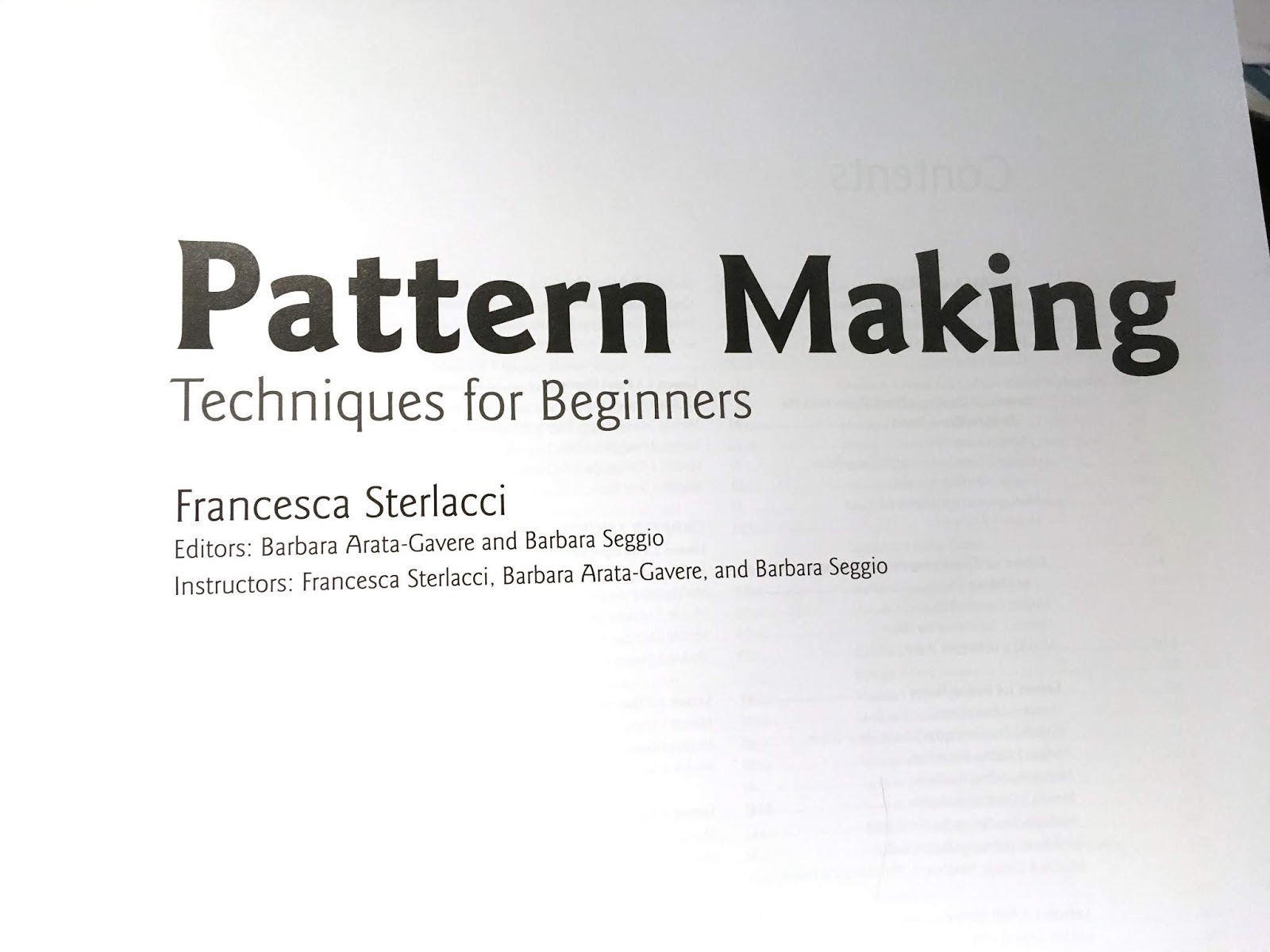
Pattern Making / Draping -- Techniques for Beginners 2019 Book Reports Continue

More book reports. Because summer reading.
I'm not sure how much you enjoy these book reports, but I must reinterate that sometimes I put things on my blog so that I can find them later. It's a public storage unit. 
Spoilers: I liked these books. Apologies for the terrible photos.
You can click on them to make them bigger, or just race on by them to get to the ones Ienbiggened to discuss.
Two of three books in a series by Francesca Sterlacci for Lawrence King's sewing book collection. These are branded as the University of Fashion, which is a thing Sterlacci is doing with several other sewing related businesses. I would dig into that a little more, but it's summer and I have still have the summer job.


and of course

Putting this here to shout out the collaborators. Good job all around.

We start at the very beginning. Kind of the James Michener style of writing: start with the big bang; work out from there. Sterlacci has another book on fashion history that is well reviewed. I'll get there.


The nice thing about this is that it introduces some basic forms we'll refer to later. Schweet!
"Clockwise from left: Peplos; Ionic chiton (elbow length); Doric chiton; Himation" from caption that got cut off


We cover the beginning of the pattern industry, 


The following paragraph is a nice reminder to today's sewists about how important a fit model is to a design house.
 It's not a factory of math. Every pattern line fits differently because every pattern house uses a different model.  


Author's message below:


I enjoyed this book. The course of study is clear, the lessons flow from one to the next, there are many examples and explanations for the choices that are made.


Where to start and why


Most of this book is pictures of drawing lines. The photos are well captioned, each chapter has a nice introduction and an example photo.
We are not going to sew these things together. That is another book in the series (not reviewed here, as it wasn't available at my library yet),
Seam allowances will be touched on, but lightly.


Why are we scooping out a lower portion? I don't doubt it's important, but we don't learn why. It makes sense (fronts and backs of sleeves don't look the same - usually a little more in the back and a little less in the front so that the sleeve is set a touch forward (remember we move our arms mostly foreward). We are also drafting a fitted sleeve with an elbow dart, which is a great moment in my personal sleeve journey.
And yes, I have had a personal sleeve journey.


Remembering that this is a self-study course, there will be tips and reflections.


Button placement rule I did not know, and am going to slap up on the wall of the cave. I get tired of faking it. I do love how the caption just repeats the information in the photo.

This is a good course of study. And a nice refresher course.
Sure, I like drawings over photos, but there are loads of photos of every step.
And some boss rocking charts


The math is done for you for full and semi circle skirt charts as well.
DAMN.

The measurement guide is handy


Although the back makes it look like you're measuring for a gimp suit.

And for Ithaca Maven, the basis of how to draft your own damn pants pattern.
The Big Base Grid.


When you rotate it, it turns into this:


And ease is built into the measurement taking.


We aren't going to explain how to draft a fly. 
It's not like that button thing.


Did not know! Learning!

On to the draping book.
Same author, same approach. Lessons building on lessons.
We begin with the masters of the hands on approach,  and the photo that launched a thousand half scale model sales.


This is the book I want to read:
Pauline Trigere draping on a real live human.


I'm curious for the basic procedure: you can't stick a pin or tape a line to a human. Should I make a long line bodice to pin into...no. That's going to hurt as well.
There will be poking. How do I avoid poking? Tape?


Jeanne Lanvin, 1929, also working on a human.

The book demonstrates draping on a dress form to create a pattern. Lots of photos, clear illustrations, showing you how to create basic patterns (bodice, skirt, sleeve) from the form. I'm craving something that connects this practice to creating something unique, and this was not that book for me. 
Forgot to mention there are videos online for these lessons! 
And they are available for 19.95$ a month. Like Bluprint, you could probably boil through what you needed in a month, and then cancel. I don't have time to do that until October, but I'll think about it. The photos in these books seem to be screenshots (according to the publisher's page credits) and they catch clear points of action.

There is a free mini-subscription available by signing up for the newsletters on the website, with some nice benefits. So, a free sample to check out the goods.
But this is a book report. 

Sterlacci and her team have created a clear format for these books, and while there's the occasional boo-boo of mismatched photo to caption, the idea is clear enough that you can actually spot those few errors because the book taught you well.


The cover got warped after being left open for photos for an hour. 
Downsides to these books: they are made of heavy paper on a less than sturdy spine. When I picked these up at the library, they were being held behind the desk because of how floppy they were. They needed to be supported on the front and back or they would start to tear.
 Ruh roh.

They are sewn signatures. I like a sewn book, thank you.


Also available:


 Ida approves.